
Ever wondered about A.A.’s adopted prayer, the Serenity Prayer? Where did it come from? This could be a job for Scoob and the gang.
In case you haven’t heard or read the prayer in its full form…
God grant me the serenity
To accept the things, I cannot change; Courage to change the things I can; And wisdom to know the difference.
Living one day at a time; Enjoying one moment at a time; Accepting hardships as the pathway to peace; Taking, as He did, this sinful world as it is, not as I would have it; Trusting that He will make all things right If I surrender to His Will; So that I may be reasonably happy in this life. And supremely happy with Him Forever and ever in the next.
Amen.
Who wrote it though? Like most things it comes with many opinions, almost as many as who was Jack the Ripper.
The prayer itself is rumoured to go back as far as that Greek fella, Aristotle, a lot of his writings spoke of acceptance, change and courage. Another is St Thomas Aquinas, a friar who was around in the 13th century, his philosophy brought about what would be the serenity prayer, but alas it may not have been him who actually penned these meaningful wise words.
We could go on forever, was it St Francis, was it Sanskrit, was it the words of Friedrich Oetinger (1702-1782) who allegedly penned ‘God give me the detachment to accept those things I cannot alter; the courage to alter those things which I can alter; and the wisdom to distinguish the one from the other’, This was located on a tablet (not an apple one) in the hall of a Hotel in West Germany, a clipping from the Paris Herald was sent to A.A Grapevine in 1964. It turned out, after some deep diving researchers that the name was a pseudonym, it was actually Theodor Wilhelm, who had put the prayer in a book in 1952, so it wasn’t the actual Pietist Friedrich Oetinger…anyway.
Here we go, the person who has been attributed to the prayer and admitted to writing it, is American Theologian, Reinhold Niebuhr, (1892-1971)
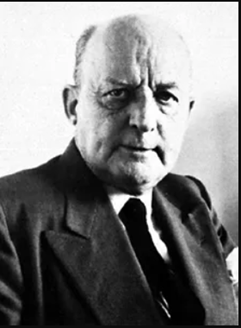
Reinhold Niebuhr presented the prayer in a 1943 sermon at Heath Evangelical Union Church. The good doctor wrote the prayer in the early 1930s. He was quoted as saying, “Of course, it may have been spooking around for years, even centuries, but I don’t think so. I honestly do believe that I wrote it myself.”
Reinhold’s daughter Elisabeth Niebuhr Sifton wrote his memoir the Serentiy Prayer which can be found in her book, The Serenity Prayer: Faith and Politics in Time of Peace and War. ’God give us grace to accept with serenity the things that cannot be changed, courage to change the things that should be changed, and the wisdom to distinguish the one from the other’.
As you can see the wording is different to what we know. Elisabeth mentions A.A. changed the phrasing of the prayer, yet you will notice further down that cannot be the case.
Another rumour as to who created it is one of the Dr’s students, another theologian, Winifred Crane Wygal. Dr Wygal was credited with helping popularise the Serenity Prayer. Winifred first quoted the prayer in 1932 in her diary, giving props, as the kids these days say, to Dr Niebuhr. This was also within her prayer book in 1940, ’We Plan Our Own Worship Services’
It reads; ‘O God, give us the serenity to accept what cannot be changed, the courage to change what can be changed and the wisdom to know the one from the other’
The Prayer was located in 1957 in a book called ’Between Dark and Dawn’ by Frederick W. Kates, the poem titled ’Fourteenth Century’.
‘Almighty God, our heavenly Father, give us the serenity to accept what cannot be changed, courage to change what should be changed and wisdom to know the one from the other.’ This wasn’t given credit to the Doctor.
But, I know what you want to know, and even though I have lost the ability to read minds, I do think you want to know…..How did the prayer come to A.A. I hear you say, murmur or shout, well, calm down……calm down.
It was the year of 1941, found in an edition of the New York Herald Tribune by Jack C, a New York member, he clocked the prayer in the newspaper of an obituary and took it straight to the New York office, to show Ruth Hock and Bobbie B; both loved it. Bill W said it is a perfect way to explain A.A. As you can see, A.A. never changed the words of the prayer, as mentioned in the book by Dr Niebuhr’s daughter.
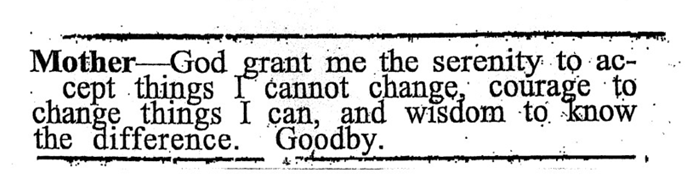
Horace C had the idea of getting it printed on small visiting cards, he said he’d be up for paying the first lot of printing. The printer himself loved the prayer, he donated 500 copies, as he could be a member in the future.
According to A.A. archives in New York, a couple of members wrote to Dr Niebuhr regarding the prayer. He responded – ‘…I did write that prayer. It was distributed by the YMVA to soldiers during the war. The prayer was printed and given to front-line soldiers ‘. I think it is fair to say he was the person who got it out there. It appears the Dr Niebuhr was using the prayer in sermons in the early 1930s and could well have been adapted from then on, which is why it appears differently to what we know within the book written by his daughter.
Bill W received a plaque inscribed: – “In creating A.A. the Serenity Prayer has been a most valuable building block – indeed, a cornerstone.”
Nell Wing (see picture below), the first A.A. archivist, mentioned she had come across a humorous ending to the prayer by writer Erma Bomback.

“God grant me the serenity to accept the things I cannot change, courage to change the things I can, and the wisdom to keep my mouth shut when I don’t know the difference…” Someone else suggested this ending: “…and the wisdom to keep my mouth shut even when I know I’m right” Nell felt this was rather apt.
Also, other 12-step fellowships have adapted it. Such as Adult Children of Alcoholics and Dysfunctional families. ‘God, grant me the serenity to accept the people I cannot change, the courage to change the one I can and the wisdom to know that one is me.’
As Dr Niebuhr stated in the correspondence the prayer may have been ‘spooking’ around for a while, but he was the first to write it.
Oh, another thing……..I’ll finish on this……the below was passed to us from a London A.A. member, ‘Dublin’ Anthony, who has gone to the meeting in the sky. Anthony was shown the meanings of each section of the prayer; Have a read below and hope it helps and shows it isn’t just something someone chants at the end of a meeting.
God Grant Me the Serenity.
I have known peace. The peace that comes in front of a fireplace on a cosy winter’s night. The peace of the mountains. But when I would leave the mountains, the peace would leave me. When the fire went out or the phone rang, the peace would be gone. Peace came rarely and went quickly a mood conjured by myself for myself. Serenity is different, it is all that peace is, but it stays. It carries over. It is with me and in me. Nothing disturbs it. It is given; therefore, it cannot be taken away.
To Accept the things, I cannot Change.
One accepts when one receives. To Understand, or take into the mind without debate as one receives a gift – that is acceptance. Serenity precedes acceptance, it must. There is order to this. My mind must be calm to understand what you are saying. To listen to you without debate. I must not be afraid of you. With the gift of serenity, I am able to accept people and circumstances as they are, not as I want them to be or as I think they should be. I am willing to accept the bad as well as the good because it is all part of the plan. When I accept a situation as it is, when I accept you just as you are, I have stopped playing God.
Courage to Change the things I can.
When my ego is involved and there’s a calculated risk, I’m going to be gutsy, not courageous. It takes guts to ski a steep trail; I alone will be rewarded. Courage is different. There is always a parenthesis of fear in courage. The risk becomes minor. This parenthesis remains a void of fear until it is filled by God. There is no ego in a courageous act. Courage can ask for help. It is often something done for someone else, or it may be something I am not attracted to doing at all. I may lose by doing it. The courageous act is often the unpopular choice, to do or not to do. The results are seldom only mine. It requires more of me than I want to think I can do, alone. After it is finished, gratitude to someone or something is usually in order. Courage requires a moral strength not of myself. This strength is given by faith.
And Wisdom to Know the Difference.
Wisdom is God’s conversation with me. Often, He speaks through books or other people. Wisdom can be found merely by listening to others after I develop the ability to hear it in their words. To recognise wisdom, I must have compassion for others, which gives me insight rather than knowledge of myself. Facing reality encourages recognition of wisdom. Because wisdom is always truth.
So, there we have it. The meaning is centuries old, the words on paper by Dr Niebuhr and adopted by Alcoholics Anonymous. Thanks to the abundance of research located in the Archives, Elizabeth Niebuhr Sifton and resources that have been made available for us to learn.
Let us give a moment’s thought to what the prayer means to you when we close off the next meeting we attend and give thanks. Story of A.A.’s adopted prayer…The Serenity Prayer.
 East London Archives of Alcoholics Anonymous.