
The story of the SSO and the London telephone office
Just to let you all know, this is being updated.
However, there had been a telephone helpline for alcoholics in London since 1948 – August 1948, to be precise – and from its humble beginnings grew the present-day service. The story really begins February 1948, when Bill H., drying out yet again in a London clinic, was twelfth stepped by Canadian Bob. Bill’s brother, Roland begins the story of L.R.T.S.:
Bill and I were buying agents of fruit and vegetables and had our offices in the London Fruit Exchange. When Bill had been sober a few months, he came to me and said, ‘These people I’m with – meaning A.A. – don’t have an office or a telephone. Would you mind If I took the entrance office from the corridor and installed a telephone for their use? adding with foresight, ‘you may need it yourself one day!’ I treated that remark with the contempt it deserved and gave my blessing. The telephone was installed in August 1948, and the number BIS 4980 duly appeared in the London telephone directory.
The first secretary was a lady called Lottie, and she was followed by Esme, a male member from Tunbridge Wells. I remember helping to run off early newsletters on a hand operated Roneo.
In 1954 Beverly Baxter wrote an article for the Daily Express, including in it the A.A number. Expecting a flash-point similar to the one that occurred after the Jack Alexander article in America, Bill, together with other members waited by the phone, car engines running, for the deluge of calls, but alas on that day there was no reaction.
I accepted membership of AA while a patient in Warlingham Park in 1959, seeking the help I could have found ten yards from my desk.
In its early days A.A had one group in London, which used to meet in a room in the Shaftesbury pub. The next A.A contact outside of London was Alan B in Blackpool. However, A.A began to grow, not only in London but throughout the country. After the visit to London of Bill Wilson and Lois in 1950 a donation of 1,500 copies of the big book was received from A.A. in America. A committee was formed to appoint a board of trustees to administer the sale of the books.
Eventually a central service office was formed as the forerunner of G.S.O. Offices were leased in Redcliffe Gardens, Kensington, on 1955 the telephone helpline was transferred from the fruit exchanged to Redcliffe Gardens. Central Service Office taking calls for help between the hours of 10am to 6pm. The telephone was not manned during the evening or at weekends and bank holidays. At this time there were fewer private telephones. Twelfth step calls were sent by letter to the nearest Group Secretary, who would read out the letter at the meeting and ask for volunteers to do the twelfth step. Fewer members had cars and twelfth-steppers would often have to undertake quite a long journey by public transport. The whole process could take weeks, and the twelfth steppers could be confronted with an alcoholic who was, in Joe E’s words, three parts cut and asking, ‘Who the hell are you?’ Towards the end of the fifties there was a strong feeling amongst some of the members off the London Groups that a better system for passing out the twelfth steps calls had to be found. However, to recognise the need for a better system and then to agree on whether it was necessary, and if so to reach agreement on the type of system required, who would be responsible for running it and for some of them got quite heated, between Group members, the representatives of the Area and Group committee (The forerunner of conference) and the central service board members.
Vincent S, Joe E and Trevor O continue the story. Vincent writes. My recollection of the period is a series of meetings in Caxton Hall to decide whether or not the formation of an intergroup in London was desirable, the year 1961. A London Intergroup was duly formed and one of its ambitions was to setup a telephone answering service. Trevor recalls:
Around 1960 the area and Group representatives committee which covered the membership countrywide, selected a man called George M, from Streatham as their chairman. He persuaded Padge, the then General Secretary to allow volunteers to extend the telephone helpline hours to 10pm, the period from 6pm to 10pm to be manned by volunteers from the London Area.
G.S.O. provided office space and a desk at a peppercorn rent. A separate telephone line was installed. Joe had the number inserted into the Essex telephone directory at a cost of six guineas. It was the only London number in the Essex directory. An Office manager, Frank from the Oval, was appointed to deal wot halls from 10am to 6pm. Vicent was given the task of finding the volunteers for the evening shifts. He remembers how, when later Vincent handed over the job to him, he went around all the London Groups ‘blackmailing the members into doing telephone duty. He also remembers the first call for help coming through before the volunteer service was officially opened:
All the volunteers were assembled to been told how the new system would work. We were standing there on the Tuesday before Easter when the telephone rang, we thought it was a put-up job at first. It was from Charing Cross station, a chap who had come down from Scotland for an interview with the BBC. He’d been dried out but he’d got back on the stuff. Big Alex and one other member went straight off to the station, they had twelfth stepped him from Tuesday to Wednesday and got him to First London on Thursday. I took him home from there for the whole weekend, then Alex arranged for somewhere for him to stay. I couldn’t keep him all the time. Later, much later he became charman of London Intergroup.
Not only were Twelfth Step calls devoted exercises in which the twelfth steppe would often take the suffering alcoholic into his home, but they were often quite far afield. There were at that time 25 meetings in London and three in Essex. The aim of the new service was for each group to designate a member with a phone so that he could find twelfth steppers locally – something like the present day call out system. The aim, then as now, was for the suffering alcoholics to be contacted within 48 hours.
There were no restrictions on who volunteered for service – no recommended length of sobriety. This could make for difficulties: one evening the phone line was manned by very two drunk volunteers. On another occasions, the two A.A. member on duty smoked throughout the evening, and, having previously had complained about the office being left untidy, emptied their ashtrays into a waste-paper basket on leaving. This, caught fire and but for the vigilance of a lady living opposite who phoned the fire brigade, C.S.O and the London office would have burned to the ground, all of which didn’t exactly endear the telephone service to the staff of C.S.O. Eventually C.S.O suggested that the Telephone Service would find alternative accommodation.
In 1963 London Intergroup set up its own Telephone Service in Craven Terrace, Paddington. Members donated the necessary equipment and, as Vicent says ‘We were in business.
The London Groups, together with those in Essex, accepted the responsibility for funding the project, but alas the problems with volunteers that had occurred at Redcliffe Gardens continued to dog the Telephone Service and, together with financial problems led to growing concern for its future. Around 1965 the London Intergroup, whose chairman at that period was Maurice, with South African Jim as Secretary, felt that the service would be improved if it returned to Redcliffe Gardens where, although it would continue to be run independently by the London Intergroup, the good name of A.A would be protected under the G.S.O umbrella. The Telephone Service was duly reinstalled in Redcliffe Gardens. Between 1965 and 1974 the Telephone Service continued to be financed from group contributions to London Intergroup. The standing committee of the Intergroup appointed a member who responsibility was to ensure that the Telephone Service ran as smoothly as possible. Over the years the Telephone Service had a succession of office managers. ‘Ironing board’ Arthur took over from Frank. At various times there was a Margaret, a Bridget, a Dorothy and a Doris.
The service continued to expand as the number of London Groups grew, and volunteers were now helping to man the telephones during the day and continuing to accept full responsibility for evenings, weekends and bank holidays Marie O, shares her experience of telephone duty in those early days.
I started going in as a volunteer around 1971, so I will try to cover the period of 71 to 74 as a volunteer.
The office was to the left as you go in through the front door of Redcliffe Gardens, an A.A meetings were held in a room across the hall on a Tuesday, Friday and Saturday. We had two telephones. During the day between 10 and 6 the volunteers came from the dame background as they do today: housewives, members who had retired in fact anyone who was willing to give four hours a week to the service Like all volunteer services, some volunteers were extremely good, and others not so good. Rather like today, some volunteers seldom arrived on time, and some didn’t arrive at all. Quite often alcoholics rang in for help and were invited into the office for twelfth stepping, so it wasn’t at all surprising if you came on duty at 6pm to find one or more drunks either creating chaos or asleep on a chair or lying on the floor. The office itself was very depressing. To come n duty after a hard day’s work in one’s own office to find a table in the middle of the room covered with dirty cups, kettles, sugar and milk as not terribly inviting. Of course, we had no kitchen, so all the washing up was done in the wash handbasin in the loo. I’m sure you can imagine how difficult it was keeping the office clear of drunks and keeping sober members who were attending their meeting next door way from the telephone room.
There was terrific difficulty getting rid of twelfth-step calls at this time, and although we had a very extensive file of names and telephone numbers it might well have taken fifteen or more calls to get passed out. It was just impossible to keep those files up to date, with people moving or drinking. Of course, callers were often directed to go to meetings, instead of being twelfth stepped. As A.A in London continued to grow the change in the membership was very noticeable. There were many younger members and more women coming to meetings. I remember how enthusiastic we all were to get involved in carrying the A.A. message.
The next event to have an impact on the Telephone Service occurred early in 1974. London then had around 101 groups. A number of Groups in South London decided to leave London intergroup and form an Intergroup of their own, a move which was unacceptable to London Intergroup and which it opposed. South London’s decision was eventually discussed at all levels of A.A. Finally, a meeting was held to enable members to decide the future of London Intergroup. The Last Chairman of London Intergroup writes of the outcome:
Suggestions from G.S.O. indicated an opinion from G.S Board and other areas called for consideration to be given to some form of change. He options became
- For London Intergroup to remain as it was;
- Adopt a Zone System (based on the San Francisco experience)
- Areas to form into separate Intergroups.
The result eventually was formation of five intergroups – London Central, London West, London North and East, London South-East (plus South London).
This left the now ‘groupless’ London Intergroup with a duty to ensure the responsibility of maintaining the Telephone Service was accepted by the new Intergroups. At a meeting of General Service Board members, the General Secretary and the Chairman or Chairman-elect of the Intergroups, the assurance was obtained and the London Intergroup chairman, having carried out his final task, effectively closed down London Intergroup.
The financial balance of London Intergroup was distributed 50% to the Telephone Service (no to be called L.R.T.S) and 50% to G.S.O for the General Fund. Essex Intergroup also pledged continued support of volunteers and finance at this time.
(This account may help to dispel any confusion among some new members who think that L.R.T.S. is run by London Region).
One of the first tasks for Intergroup chairmen were faced with was to employ a new office manager. The Chairmen’s choice was Marie, and she continues her sharing:
I remember getting a telephone call from Leslie C., Chairmen of Central, asking if I would consider taking the job as Office Manager. I had often heard about the pressures of the job and the stress it had caused to many who had already held the post, and so I said no, I would rather not take it. However, at the Southern Convention later in that month, I was approached again, but I was still very hesitant. A few nights later, when the five Chairmen met again at 11 Redcliffe Gardens, they invited me to come in for chat. They assured me of their full backing and cooperation and it was agreed that I would accept the post for six months and if I or they felt that the strain was affecting my sobriety I would not continue.
Before I could feel comfortable, I knew I had several things to do, like working in a bright, clean, tidy and calm office, so that and the volunteers could give of our best. We got the office painted and carpeted as soon as possible. Another very important matter was to keep the office as free of visitors as possible, I mean drink or sober, so that we could concentrate on answering the phones calmly and without distraction. This wasn’t always possible, and I had to take a bit of stick from some of the members Of course, no one needing help was every turned away. Finding a better system to pass out the twelfth step calls was a priority, and we felt that allowing each Intergroup to be responsible for their own twelfth-stepping would be of help. So, we just had to get a system going. Each Intergroup then appointed a Telephone Rep., and they formed a committee for the day-to-day liaison between the office and their own intergroups. They were responsible for the evening and weekend volunteers for the office, as well as having a team working from their own home who were willing to call the office around 6pm. and three times Saturday and Sunday accept details of any calls for heel in their area.
Telephone Representatives were responsible for compiling an up-to-date Twelfth-Step list to enable the calls to be passed out within their Intergroup. I also thought it was important, as each and every Intergroup was financing the office, that they should know exactly what went on in the office and what the traffic was like, so I began producing the monthly figures, which gave those Groups that were paying into the Intergroup some idea of the traffic involved. This practice is still adhered to.
Other changes were introduced. The Intergroup Chairmen decided that forward budgeting was necessary to ensure that L.R.T.S. remained solvent. Intergroups were asked to provide a yearly sum of money based on the number of Groups in their area, the sum to be calculated at ‘X’ amount per Group per week. The chairmen also decided that annual audited accounts would be presented, thus allowing members, through their Intergroup, to see what happened to the contributions they made to L.R.T.S. Both practices still apply.
Towards the end of the seventies both G.S.O. and the Telephone Service needed room to expand; the solution was for L.R.T.S.s to move out of Redcliffe Gardens. Dougald F, Duncan McG, and Van were given the task of finding a new home. Duncan McG had a non-A.A. friend who was responsible for the letting of G.L.C property. He was approached and he provided a list of available premises to rent. Dougald F recalls how:
Van and I tramped many miles around Central London looking at empty offices. We had settled on a suitable property in Viner Street, close to Trafalgar Square. G.S.O. was close to signing the lease on behalf of L.R.T.S.s when by chance Duncan visited the area late on evening, where he found that the quiet area by day was a hive of activity by night. Further enquiries showed that the ‘employment agency’ on the ground floor at Viner Street had a fast turnover of very friendly ladies.
Dugald and Van returned to their search, eventually recommending 7 Moreton Street in Pimlico as a suitable location. The building was scheduled for redevelopment and was in a bad state of repair, but it was affordable. Money, as usual, was tight, but the setting-up of the new office showed A.A at its best. Volunteers were found to clear out several skipfulls of rubbish. Paint was donated, and other volunteers repaired, decorated and cleaned the rooms. Dugald had a non- AA friend who was a member of Lloyds of London. He tells us, they had a quantity of office furniture to dispose of, and the offered it to us if we could transport it. A member provided his laundry van, and another member provided a lock-up garage as a storeroom until the furniture was needed. Finally, Dugald installed the central heating, and in 1978 L.R.T.S. move into its own suite of offices. The desks, filing cabinets and chairs that once graced Lloyds of London are still used by L.R.T.S.
With the move to Moreton Street the Telephone Service had room to expand. Marie was able to introduce a more sophisticated service. She recalls:
Because we were now opening the Service and increasing our lines to three incoming and one outgoing, I suggested Telephone Workshops. As you can imagine I came in for a lot of stick now, although I was fully supported by the Chairmen and Telephone Reps. To begin with, certain members absolutely refused to attend, but as time passed it began to be accepted as a desirable way to familiarise the volunteers with the standard procedure.
Towards the end of the seventies and beginning of 1980 the five London Intergroup were experiencing problems of growth, not only numerically but in some cases also geographically. For instance, London South-East had spread from Inner London Groups out as far as Swanley in North Kent. Once more problems of twelfth-stepping were arising, groups close to Central London having little contact with Group ‘out in the sticks. The result was that the intergroup wanted to re-form into a smaller and more closely knit units. The call-in system couldn’t cope with a large number of members ringing in to check if there were any twelfth-step calls for their area. The decision was taken to change to a call-out system which the intergroups to reform. At the same time, it enabled those Intergroups on the outskirts of London that had been for some time expressing a desire to join L.R.T.S. to become fully paid-up members.
With the increase in the number of intergroups the Chairmen’s meeting was becoming unwieldy, particularly in the management fi the finances and the day-today running of the service. The decision was taken to form a Telephone Management Sub-Committee that would act on behalf of all the Intergroup Chairmen and which was empowered to take decisions on any problems, financial or otherwise, that might occur on a daily basis, reporting back to the chairman of the regular Chairmen’s meetings. However, all decision taken by the T.M.S.C. were, and still are, subject to scrutiny and final endorsement by the Chairmen’s meeting.
In 1983 the landlords of 7 Moreton Street wished to develop the site, and once more L.R.T.S. was looking for a new home. A basement flat was found in Tachbrook Street, a few hundred yards away from Moreton Street. This tie the move was not quite so traumatic and again volunteers did the cleaning, decorating and furniture removal. Marie somehow managed all the upheaval of the various moves without any disruption to the Telephone Service.
During the year that L.R.T.S. was at Moreton Street and Tachbrook Street, London Region had been set up. More Intergroups had re-formed themselves and G.S.O had moved to York.
In 1986 L.R.T.S. yet again found itself looking for new premises, the building in Tachbrook Street having been sold. At the same time the ease for 11 Redcliffe Gardens was put back on the market. Negotiations were entered into and the L.R.T.S. was able to lease the premises formerly occupied by G.S.O. In December 1986 L.R.T.S. moved back into Redcliffe gardens. It had come back full-circle, but this time occupied the premises as lessee.
When Mari O became Office manager in 1974, she took over the Telephone Service that was, to say the least chaotic. No office manager had stayed for any length of time she took on the task of turning a well-meaning but amateurish telephone office into an efficient well-run service. As Marie recalls:
Working with volunteers is not without its pressure on the Office Manager it’s not like an ordinary office where the staff don’t change every four hours and where you can insist on the staff always following office procedures. However, it wouldn’t have been possible to run the office without the splendid A.A spirit and good will show by all the volunteers. As the system grew ad became more complicated, I don’t know how I would have got anything new across to the volunteers without the aid of the workshops. After the move to Moreton Street, we had over 400 volunteers a month going through the office. I found all these moves very heavy, both physically and mentally, to move a volunteer office, to familiarise everyone with a new telephone number, and on two occasions with a new telephone system, really was quite heavy. And indeed, our workshops were very important at this time.
Despite the several moves, the changes and the pressures I found my 14 years with L.R.T.S. a most rewarding experience which has left me with a host of happy memories ad many, many good friends.
In 1988 what can only be described as a shock wave through the Groups. Marie, whose health had been failing for some time, announced her retirement after 14 years no one could imagine L.R.T.S. without her. When she left on 31st October 1988 for her well-earned retirement in her native Ireland, she, to quote her successor Maria, ‘handed over a smooth-running machine with proven office procedures and a dedicated body of volunteers’.
Since Maria took over, she too has made changed. She introduced computerisation, which has not only reduced volume of paper work but has also increased the efficiency of keeping up to date all the relevant information the volunteers need. Today’s office has some 400 volunteers to man 5 lines. The computer holds details of the 500 meetings in the area services by L.R.T.S. plus the rotas which allocate evening and weekend shifts among the 17 Intergroups.
L.R.T.S. has come a long way from the first telephone helpline in the London Fruit Exchange. With the support of the Groups, it has survived all its early traumas, the several moves and all the changes it has gone through. The idea of a Telephone Service came from the groups. It was the Groups that saw the need for a better, faster way of passing out the Twelfth-Step calls. It was the groups that gave London Intergroup the original mandate to set it up. It is the Groups that finance it. It is the Groups that will continue to nourish it and guard its independence from any outside interference. L.R.T.S. shows what the power of the groups can achieve. –
March 1992.
WE WILL BE UPDATING THIS TO THE PRESENT DAY – 2025
1999 – The London Telephone office moved from Redcliffe Gardens to its new home of Jacobs House, Cynthia Street, N1.
Jacobs House, Cynthia street was later sold and knocked down for apartments to be built, so, members of the Southern Service office went out on he hunt to look for a new venue for the phone office and low and behold they found a venue near Tower Bridge:-
The office was moved in 2014 has been:-
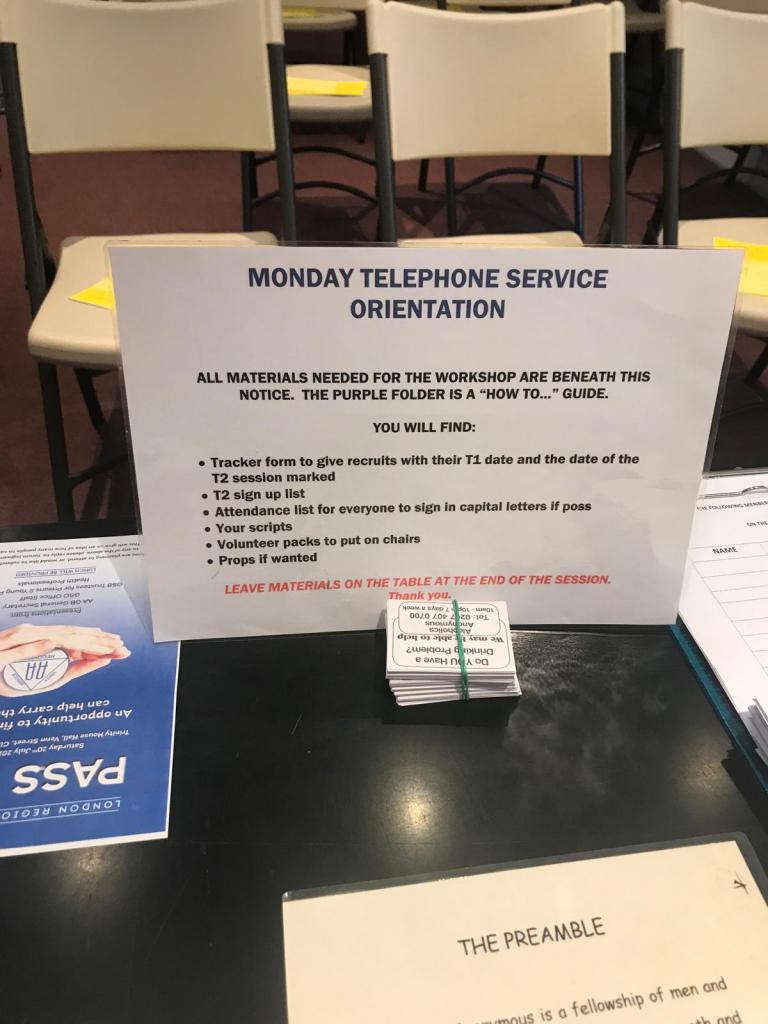
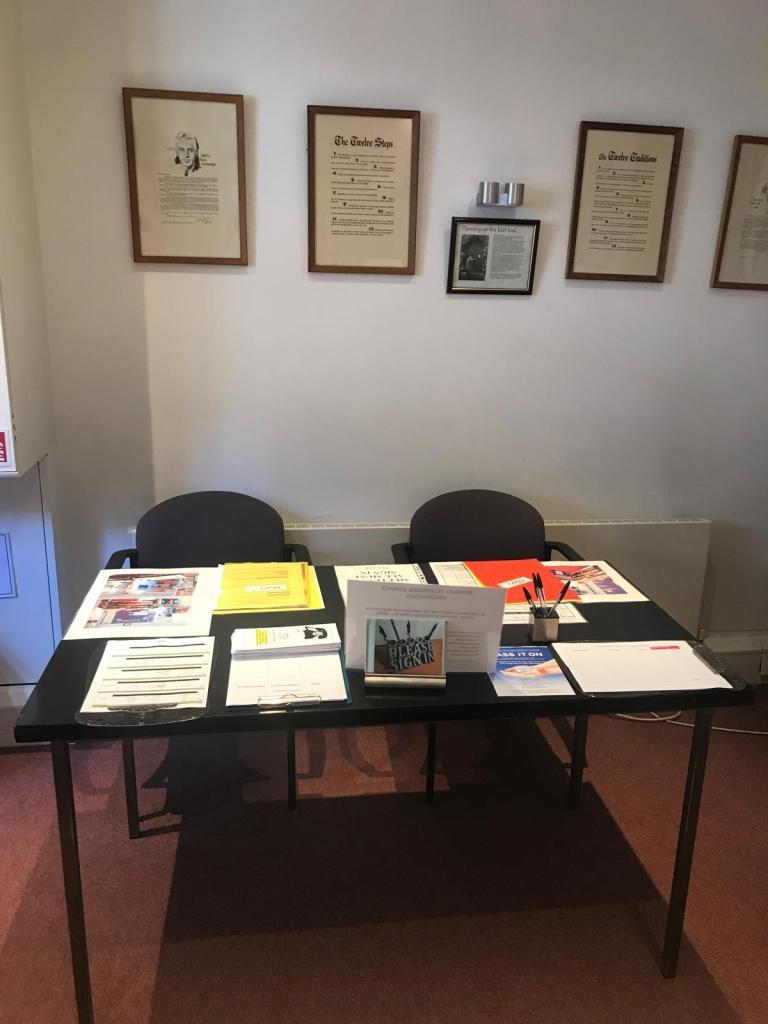
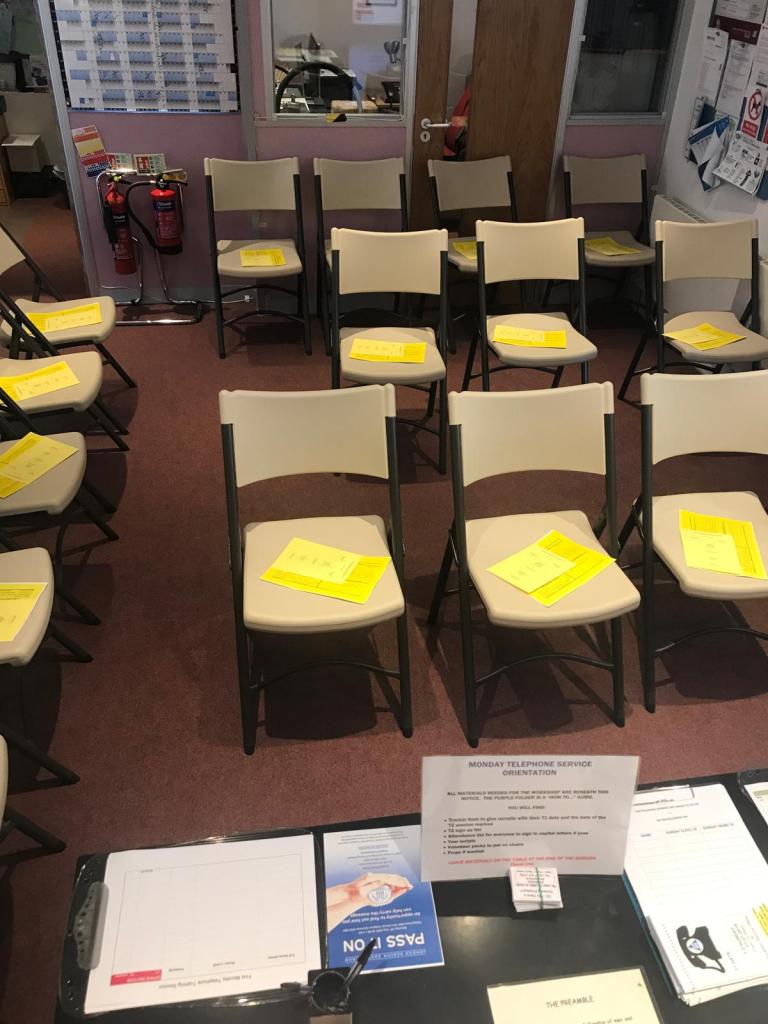
1 Raven Wharf, 14 Lafone St, London SE1 2LR
2024 – New premises were sort after Bells Yard Mews.
 East London Archives of Alcoholics Anonymous.
8 thoughts on “History of London Telephone Office”